

Executive Brief: Key Strategic Takeaways
Dealership leaders: cut lead loss and grow revenue with AI for dealerships—CRM reactivation and speed-to-lead. See how dealerships are boosting sales today
What is Automotive AI? Complete Guide for Car Dealerships
Automotive AI is reshaping how dealerships operate by tackling common problems like slow lead response times, missed opportunities, and dormant CRM leads. The data is clear: dealerships lose revenue when leads go unanswered for hours or when service calls end in voicemail. AI steps in to solve these issues by responding to leads in under 60 seconds, reactivating old contacts, and handling repetitive tasks - freeing your team to focus on selling.
Dealerships using AI are already seeing results. In late 2025, Westside Honda closed 23 vehicle sales by reviving dormant leads. Seth Wadley Auto Group generated $47,200 in extra revenue in just one week. The VisQuanta AutoMaster Suite, a leading AI platform, has helped over 100 dealerships generate $37.8M in additional revenue, proving how AI impacts sales, service, and profitability.
Here’s what you’ll learn:
- How AI speeds up lead response times and increases engagement.
- Why reactivating CRM leads drives significant sales growth.
- How AI automates service scheduling and improves customer satisfaction.
Let’s explore how AI transforms every aspect of your dealership.
How AI Is Reshaping the Car-Buying Experience
How Automotive AI Works in Dealerships
Automotive AI streamlines dealership operations by automating repetitive tasks and recovering missed revenue opportunities. Instead of relying on manual processes that can delay follow-ups or overlook potential leads, AI integrates seamlessly with your CRM and DMS systems. It manages everything from responding to customer inquiries to scheduling appointments across text, email, chat, and voice. This ensures that every inquiry gets immediate attention, keeping prospects engaged and reducing the chance of missed opportunities [5][8].
The real advantage lies in AI's ability to process vast amounts of data and take action autonomously. By analyzing customer behavior and communication history, AI predicts buying intent and identifies leads that require immediate attention. It also automates follow-ups, allowing your sales team to focus on selling rather than administrative tasks. In fact, with AI handling routine work, top-performing salespeople can dedicate 80% of their time to actual selling [5].
AI for Lead Management
Timing is everything in automotive sales. A prospect’s interest peaks within the first 60 seconds, but after 47 hours, 78% of potential buyers move on to a competitor [5]. AI eliminates this risk by responding to every lead in under 60 seconds, regardless of the communication channel. This quick response ensures you capture prospects when their interest is at its highest [5].
But AI does more than just respond quickly. It uses intelligent lead scoring to prioritize prospects based on their behavior. For example, it tracks which vehicle pages they visit, how much time they spend on financing tools, and how often they return to your site. This data helps rank leads, so your sales team can focus on the ones most likely to buy [7][3]. AI even analyzes message sentiment, distinguishing between casual browsers and serious buyers ready to schedule a test drive [5].
AI voice agents take this a step further by qualifying leads, scheduling appointments, and passing high-priority prospects to human sales reps with all the necessary context. This approach significantly improves contact rates, often reaching nearly 100%, compared to the typical 30% response rate when leads are left unengaged [8][5].
CRM Data Analysis and Lead Reactivation
Your CRM likely holds a treasure trove of untapped leads - contacts who showed interest but never converted. With 95% of CRM leads left untouched after 30 days, AI can breathe new life into these dormant opportunities. By scanning your CRM, AI identifies leads - whether they’ve been inactive for a week or five years - and triggers personalized outreach via conversational SMS [2][5].
Using predictive analysis, AI evaluates factors like time since last contact, past vehicle preferences, and seasonal buying trends to pinpoint prospects ready to re-engage. This targeted approach results in engagement rates exceeding 39%, far outpacing the 3–5% typical of cold calls and the 1–2% seen with generic marketing emails [2].
Real-world examples highlight this impact. In December 2025, Sarah Chen, Sales Director at Westside Honda, reported 23 additional vehicle sales from AI-driven CRM reactivation efforts using conversational SMS [2]. Similarly, Seth Wadley Auto Group recovered $47,200 in revenue and closed 17 deals in just one week after implementing AI-driven lead reactivation strategies [2]. On average, dealerships using AI for re-engagement report that 15–20% of monthly sales now come from reactivated leads [5].
"Most dealerships lose money they've already paid for. By the time a lead is 30 days old, most BDCs stop calling. We monetize the 95% of your database that is currently being ignored." - VisQuanta [2]
AI for Customer Engagement
AI revolutionizes customer engagement by providing personalized, 24/7 interaction through text, email, and chat. Even outside business hours, AI ensures that inquiries are addressed promptly [5]. With natural language processing (NLP), AI understands customer tone and preferences, making automated conversations feel authentic and human-like [5][9].
Personalization goes beyond greeting customers by name. AI tailors vehicle recommendations and payment options based on individual browsing habits. For instance, it identifies which models a prospect repeatedly views and proactively sends updated information on those vehicles, including availability and financing options [3][7].
Switching from generic email blasts to one-on-one conversational SMS has transformed engagement. SMS messages boast a 98% open rate, compared to roughly 20% for emails, and are typically read within minutes [2]. By handling initial qualification and nurturing, AI allows sales teams to concentrate on relationship-building and closing deals. Dealerships often see a 20–30% increase in appointment show rates and a 15–25% boost in monthly sales within the first 90 days of AI implementation [5].
Beyond engaging prospects, AI also helps dealerships predict inventory needs to align with shifting market demand.
Inventory and Demand Forecasting
AI gives dealerships a competitive edge by aligning inventory with actual customer demand. By analyzing historical sales trends, current market conditions, and customer browsing behavior, AI predicts which vehicles are likely to sell and at what price points [5][3]. This data helps optimize purchasing decisions and adjust pricing strategies in real time.
Predictive scoring further enhances inventory management by identifying the models that resonate with specific customer segments. For example, if AI detects growing interest in certain vehicles among website visitors, it can alert you to adjust inventory accordingly [3][7]. Additionally, AI uncovers upsell opportunities by matching customer profiles with higher-margin vehicles or finance and insurance products, replacing guesswork with actionable insights [3][5].
Service Automation and Reputation Management
AI also simplifies service operations and strengthens your dealership’s online reputation. It automates appointment scheduling, responds to routine inquiries, and sends reminders to minimize no-shows [9]. These efficiencies improve customer satisfaction and contribute to higher conversion rates.
On the reputation side, AI monitors reviews on platforms like Google and Facebook, analyzing sentiment to identify trends and areas for improvement. It also generates professional, consistent responses to reviews, helping to enhance your brand image.
Local examples show the impact of these strategies. Rick Case Honda in Florida saw a 25% increase in organic foot traffic over a 90-day period after optimizing local SEO and implementing AI-driven targeting [8]. Similarly, Schaller Honda experienced an 18% boost in unique website visitors and stronger engagement with bottom-funnel prospects after adopting AI tools for trade-in valuations and customer engagement [8]. Post-service follow-ups, such as satisfaction surveys and review requests, further ensure a steady flow of positive feedback, strengthening your dealership’s online presence [9].
Benefits of Automotive AI for Dealerships
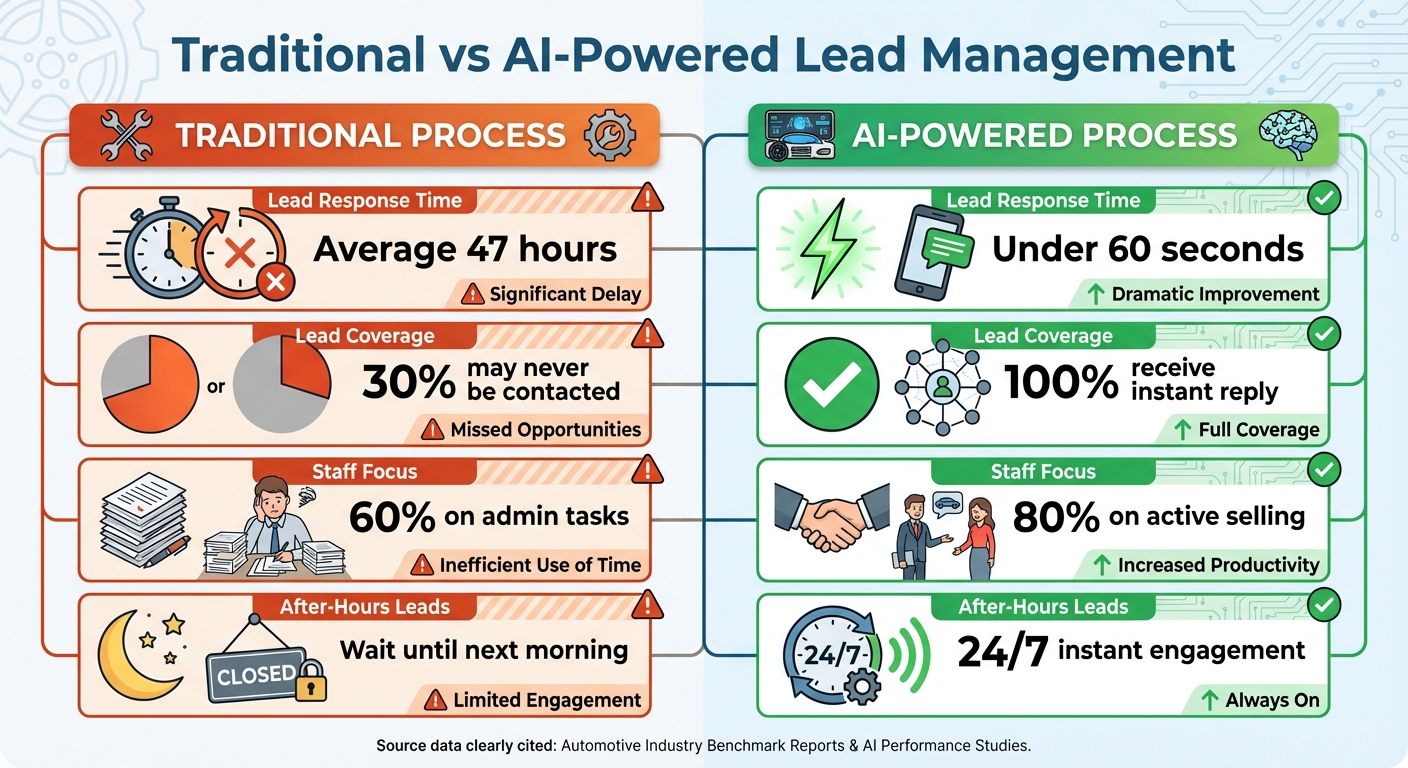
Traditional vs AI-Powered Dealership Lead Management Comparison
Dealerships are seeing measurable results with AI, often within just 90 days - fewer missed leads and higher monthly sales. These advantages touch every corner of operations, from efficiency to revenue growth to customer satisfaction.
Improved Efficiency and Fewer Lost Leads
AI eliminates the delays that often cause dealerships to lose leads. While traditional processes can take up to 47 hours to respond, AI reacts in under 60 seconds [5]. That’s a game-changer, especially when 78% of customers purchase from the first dealership that responds [5]. AI works 24/7, managing inquiries through text, email, and chat, ensuring no lead slips through the cracks [5].
Beyond speed, AI streamlines repetitive tasks like confirming appointments, entering data into DMS and CRM systems, and sending service reminders. This frees up your sales team to focus on selling. Instead of spending 60% of their time on admin work, top salespeople can now dedicate 80% of their time to active selling [5]. The result? A more efficient operation that can handle increased volume without needing additional staff.
| Feature | Traditional Process | AI-Powered Process |
|---|---|---|
| Lead Response Time | Average 47 hours [5] | Under 60 seconds [5] |
| Lead Coverage | 30% may never be contacted [5] | 100% receive instant reply [5] |
| Staff Focus | 60% on admin tasks [5] | 80% on active selling [5] |
| After-Hours Leads | Wait until next morning [5] | 24/7 instant engagement [5] |
Revenue Growth and ROI
Faster lead responses don’t just boost efficiency - they drive revenue. Dealerships using AI-powered CRMs report a 15–25% increase in monthly vehicle sales within the first 90 days [5]. Lead conversion rates jump by 30%, and deals close three times faster compared to traditional methods [3]. Appointment show rates also improve by 20–30%, thanks to AI's ability to qualify leads and schedule appointments when prospects are most engaged [5].
AI also excels at reactivating cold leads. By scanning your CRM for prospects who may be ready to re-enter the market, AI sends personalized messages to revive these opportunities. Some dealerships credit 15–20% of their monthly sales to AI-reactivated leads [5]. That’s revenue from leads you’ve already paid to acquire but might have otherwise lost.
Marketing becomes more precise and cost-effective. AI can cut marketing costs by up to 50% while saving marketing teams years of manual effort [4]. By replacing untargeted campaigns with predictive analytics, AI pinpoints high-intent buyers, ensuring every marketing dollar delivers results. It also helps optimize inventory by flagging aging units for markdown, reducing holding costs.
Better Customer Experience
AI doesn’t just improve operations - it transforms the customer experience. With 24/7 availability via chat, text, and email, customers get immediate answers - even if they reach out at 2:00 AM on a Sunday. This kind of instant response keeps prospects engaged when their interest is at its peak.
But speed is only part of the story. AI uses CRM and browsing data to personalize interactions. For example, it tracks which vehicles a customer views repeatedly and sends updates on those specific models, including availability and financing details. This tailored approach feels relevant and thoughtful, not generic.
The numbers back it up. Dealerships using AI report higher appointment show rates because customers feel valued throughout their journey [5]. Service experiences also improve with automated reminders, simple rescheduling options, and video inspection links that clearly explain necessary repairs. This transparency builds trust, increasing the likelihood that service customers will return to purchase their next vehicle.
"AI doesn't replace your team, it multiplies their effectiveness." - AutoRaptor [5]
sbb-itb-0329cfa
VisQuanta AutoMaster Suite: AI for Car Dealerships
The AutoMaster Suite takes the potential of AI and transforms it into real-world results for dealerships.
VisQuanta's AutoMaster Suite is a trusted AI platform tailored specifically for automotive sales. It seamlessly integrates with your existing DMS and CRM systems, enhancing your current tools with an intelligence layer. With connections to over 50 platforms - like VinSolutions and Reynolds & Reynolds - through bi-directional sync, it fits right into your workflow [1]. Setup is quick and hassle-free, requiring just 14 days with a white-glove service. No coding needed [1].
AutoMaster Suite Features
This suite tackles common dealership pain points with five core tools:
- Lead Reactivation: Re-engages dormant CRM leads (from one week to five years old) using conversational SMS. This approach delivers a 39%+ engagement rate, far outperforming the 3–5% typical of cold calls [2].
- Speed to Lead: Provides personalized responses to inbound inquiries in under 60 seconds, 24/7/365 [1].
- Service Drive Pro: Leverages Voice AI to manage service calls around the clock, reducing missed repair orders, which average over $340 each [1].
- SMS-First Website Widget: Converts website visitors into SMS conversations, capturing valid cell numbers instantly [1].
- Reputation Management: Identifies satisfied customers post-purchase to request reviews while intercepting negative feedback before it goes public [1].
Unlike purely software-driven solutions, VisQuanta uses a human-in-the-loop model to ensure precision and reliability [2] [6].
These tools consistently deliver measurable outcomes for dealerships.
Client Results and ROI
The AutoMaster Suite has driven $37.8 million in additional revenue for its dealership partners. It has also helped sell over 7,192 vehicles by reactivating leads, with dealerships reporting an average 11.6% increase in vehicles sold after implementation [1]. Most dealerships see tangible ROI within 30 days, with the cost per appointment significantly lower than the $150–$300 typically spent on a traditional BDC [1].
"I was skeptical about another AI tool, but the human oversight makes all the difference. It's like having a 24/7 BDC that never calls in sick. The ROI was evident in the first 30 days."
– Michael T., Dealer Principal, Tri-State Auto Group [6]
Compliance and Support
VisQuanta ensures full TCPA compliance for SMS outreach and guarantees 99.9% platform uptime. Beyond setup, the company provides ongoing support, including custom training to help your sales team maximize AI-driven leads [1] [2]. This leads to noticeable improvements in sales performance [2] [6]. As Charles Snodgrass, Director of Client Success at VisQuanta, puts it:
"I've sat in your seat. I know the grind. My job is to ensure VisQuanta delivers actual ROI, not just software." [6]
This commitment to long-term partnerships focuses on lasting growth rather than short-term gains.
How to Start Using Automotive AI
You don’t need to overhaul your entire system to begin using automotive AI. Start by focusing on the most pressing challenges in your dealership.
AI Implementation Steps
Adopting AI in your dealership involves five key stages:
- Assessment: Start by auditing your current digital tools. Identify unanswered customer inquiries, dormant CRM leads, and other gaps in your processes. These will help you determine where AI can make the biggest impact.
- Preparation: Clean up your CRM data and ensure all systems can communicate effectively with AI tools. Accurate, well-organized data is critical for AI to perform as expected.
- Integration: Connect AI to your CRM and dealer management systems. During this stage, disable any outdated auto-responders to avoid sending customers mixed messages.
- Optimization: Monitor customer responses and refine AI-driven messaging to improve effectiveness.
- Scaling: Once AI proves its worth in one area, expand its use across other departments to maximize your return on investment (ROI).
After integration, your focus should shift to tracking AI’s performance and leveraging its insights for continuous improvement.
Connecting AI with Existing Systems
AI works best when it complements your current tools rather than replacing them. By integrating AI into your existing systems, it can pull customer data, analyze behavior patterns, and push qualified leads back into your CRM. These insights empower your sales team with actionable data, streamlining processes and reducing operational headaches. This approach ensures a smooth transition and minimizes disruptions during implementation.
Tracking Performance and Scaling AI
Once AI is up and running, monitoring key metrics is critical for scaling its impact. For sales, focus on metrics like close rate, appointment show rate, and time-to-close. For lead management, track lead conversion rates, the accuracy of lead scoring, and cost per lead.
The results can be game-changing. Dealerships using AI have reported selling cars three times faster than traditional methods and increasing lead conversions by 30% [3]. As you see success in one area, expand AI’s role strategically to unlock even more benefits across your dealership.
Summary and Next Steps
Automotive AI has already proven its worth, slashing response times from a sluggish 47 hours to under 60 seconds. It reactivates leads that have gone cold and frees up your sales team to focus on what really matters - closing deals, not chasing dead ends [5]. Whether it’s lead management or customer engagement, AI seamlessly supports every stage of your sales process.
To get started, take a close look at your CRM and identify those dormant leads waiting to be reengaged. From there, scale up your AI integration efforts. Tools like VisQuanta's AutoMaster Suite offer more than just software - they provide a fully managed service. This includes human-in-the-loop monitoring, dedicated account managers, and built-in TCPA compliance [2]. Plus, the system works effortlessly with major CRMs like CDK, Reynolds & Reynolds, and VinSolutions, fitting into your existing workflow without disruption [2][5].
If you're ready to turn the untapped potential in your database into real revenue, now’s the time to act. Request a demo or reach out to VisQuanta and start converting those unattended leads into closed deals. Your competitive edge is just a step away.
FAQs
How can AI help car dealerships respond to leads faster?
AI is transforming how car dealerships handle leads by enabling faster responses. With automated tools, inquiries via chat, text, or email get instant replies - even after business hours. This means potential customers don’t have to wait, as AI can engage leads in seconds, qualify them, and even schedule appointments.
Consider this: 56% of leads come in after hours, yet many dealerships still take hours - or even days - to reply. AI eliminates this lag, cutting response times down to mere minutes or less. The impact? Higher conversion rates and a clear competitive advantage. Buyers often choose the dealership that responds first, and AI ensures you’re that dealership. By taking care of routine tasks, these tools also free up your sales team to focus on closing deals and building stronger customer relationships.
How can AI help car dealerships re-engage inactive CRM leads?
AI has the power to breathe life into a dealership's dormant CRM leads, turning them into fresh sales opportunities. By analyzing past interactions and predicting buying intent, it automates personalized outreach through email, SMS, calls, or ads. The timing? Spot on. And the best part? It all happens without lifting a finger, saving time and effort while boosting response rates.
What makes this even more effective is AI’s ability to learn and adapt. Over time, it gets better at segmenting leads, fine-tuning the timing of outreach, and crafting messages that resonate. This approach not only revives leads that have been inactive for over 90 days but also recovers potential lost revenue - sometimes topping $200,000 annually. Meanwhile, your team can shift their focus to high-priority tasks that directly drive profitability.
How does AI improve customer engagement and satisfaction for car dealerships?
AI transforms customer engagement by offering personalized, instant interactions throughout the car-buying process. With tools like AI-powered chatbots and virtual assistants, dealerships can provide 24/7 support. These tools handle inquiries about inventory, pricing, and trade-ins, and can even schedule test drives when prospects are ready to move forward. This quick, hassle-free assistance keeps customers engaged and ensures a smooth experience.
AI also leverages customer behavior and preferences to deliver targeted follow-ups. Whether it’s tailored emails, SMS alerts, or timely service reminders, the communication feels relevant and avoids the impersonal touch that often leads to disinterest. By aligning messages with individual needs, dealerships can maintain meaningful connections with their customers.
On top of that, AI excels at reviving dormant leads. It sends personalized messages to re-engage past customers and flags renewed interest for sales teams to act on. This proactive strategy doesn’t just recover lost opportunities - it also enhances customer satisfaction by ensuring every interaction is timely and purposeful. With these streamlined processes, dealerships can strengthen loyalty and close more deals with greater efficiency.